Ambedkarite Buddhist Women and their everyday life in India: A study across changing time
I measure the progress of a community by the degree of progress women achieved.
Dr.B. R. Ambedkar
Women’s religious life is very difficult, as no religion can give them the right to live freely. Religion confines women’s lives through the traditions and cultural norms, which are mainly created by men and from a patriarchal perspective.
Religious systems tend to foster and promote the power and voices of men at the expense of the women who make up the majority of adherents. In the Indian context, people of various religions reside in India. Every religion has its unique aspects, ideology, and practices. A majority of Indian people have faith in one or the other religion, they live a religious life in private and public domain. For instance, in the Hindu practices, they wear religious thread on their wrist, they wear ashtgandh (saffron colour) on their forehead, and they wear religious clothes also. Through all this, we recognise the religious people. It shows that they carry their religious identity every day. The question of women’s religious life remains controversial because men have controlled women’s religious life. In many religions, men run the human culture; most aspects of human culture have been run by men, who have often used them to control women.
The reason I am discussing men and religion here is that through this article, I aim to explore the gendered aspects in the religious lives of Ambedkarite Buddhist women. In the contemporary period, women have gained awareness of their rights in various aspects, including religious, political, social, educational, and economic rights.
Women have begun making choices about their lives and are trying to follow the paths they have chosen. But many women still live their lives under the control of men, because they are not financially independent. They have spent their entire life in doing house chores and looking after their family. Therefore, they have not been to live freely. So, they have had to be dependent on their husbands’ earnings and have also been subjected to family pressure that women should stay at home and take care of their children, husband, and in-laws. Within the larger context of women’s lived realities in the Indian context, I aim to explore why it is essential to understand the lives of Ambedkarite Buddhist women.
I argue that the majority of Ambedkarite Buddhist Women are very educated and have become financially independent as a direct consequence of following the Ambedkarite Buddhist ideology. Their education and financial independence have thus ensured that they are not bound by the social constraints that society has historically imposed on women, and they are able to achieve a greater degree of freedom in their everyday lives than they did earlier.
I argue that these achievements of the women in my sample are rooted in the fact that Buddhism teaches us to engage with life’s challenges rather than escaping them. Such teachings have deeply inspired these women. They have therefore also found the path that gives them greater freedom in their everyday lives. As my respondent discussed, the Buddhist Path gives them freedom from all custom-based practices.
They have faith in the path that Dr. B. R Ambedkar showed them through Buddhism. His life inspired them and helping them to find a meaningful life. The Hindu caste system in India has created a system of unequal status by birth for human beings. Therefore, finding ways to overcome and dismantle such a system became crucial for these women to lead an intellectual and meaningful life.
Conversion of Dr. B. R Ambedkar in Buddhism
Dr. Ambedkar was one of the most educated person in India. He acquired advanced degrees in social sciences. And the law from the best universities in the UK and the US. And through this he studied all social aspects in India and has written many books on the inequalities in Indian society and its religious problems. In his exemplary and pioneering works, he has brought out how deeply Indian society is based on caste and religion, where there is a high and low status assigned to people and people are discriminated against on the basis of their caste in the society. He himself experienced discrimination while getting an education because he belonged to a lower caste.
Untouchability was practised with certain castes, and Ambedkar belonged to one of these castes. Therefore, he devoted considerable time and energy to studying the religions of India in great depth and ultimately decided to convert to Buddhism. He finds that only the Buddhist path would lead to a better life, because in the Buddhist religion, all are equal, man is at the centre of the Buddhist religion. Therefore, he embraced Buddhism along with half a million people and showed the new path to live life. Dr. Ambedkar was also concerned about women’s lives in India because women could not move freely in society, were prevented from getting an education, and had a secondary position in society. Within the patriarchal structures of Indian society, women were considered inferior and therefore confined to the domestic domain. Such discriminatory practices placed women’s lives entirely under the control of men. In independent India, Dr. Ambedkar drafted the Hindu Code Bill to codify women’s rights in various domains legally. However, most educated people of the time, who belonged to the dominant castes, opposed the idea of the Hindu Code Bill, and it was ultimately rejected in parliament. Buddhism, however, does not restrict either the educational opportunities of women or their religious freedom.
Ambedkarite Buddhist Women and their life.
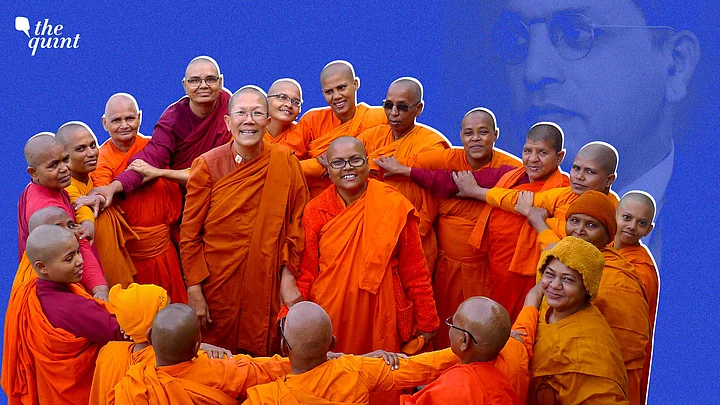
I have interviewed four Buddhist women. While interviewing them, I could understand that all of them are well-educated. Three of them have completed their PhD. They are now employed in reputable Indian educational institutions. One has done her master’s and is working in a well- recognised NGO. All four women whom I interviewed are aware of the gender / human rights. Apart from their jobs, all four of them are associated with social movements and socially engaged with Buddhism. They are recognized within social, academic and political circles as activists who fight for equality. When I asked them about which of Buddha’s teachings they follow the most in their daily life, they all answered that they like the Buddha’s teachings like “Att Deep Bhav”, Maitri, Karuna, Anitya (impermanence), the most, and they practice these teachings in their daily life. They also believe in the path that Ambedkar has shown them of liberty, fraternity and equality. All of them have mentioned this principle in their interviews.
None of them believes in the religious ritual; they all reject it. They believe in being rational and identify as Buddhists. For them, to live as a Buddhist is not to live religiously, but to live rationally. Like many Buddhists, they practice meditation; all are inspired by Dr. B. R. Ambedkar’s life and his work for society. He encouraged people to pursue higher education and work in academic settings. He also helped lower-caste people get jobs in government sectors. He made us aware of the varna system and taught us to fight against such discriminatory practices towards some communities.
Dr. B. R Ambedkar’s philosophy stands for equality, liberty, fraternity and justice, which lead to the path of enlightenment. Therefore, many people call themselves Ambedkarite Buddhists, and these four women are among them. The Buddha’s teachings and the path he showed are a framework for transforming society.
Unlike those who identify as Buddhist yet continue Hindu practices, Ambedkarite Buddhist women reject the idea of God and embrace rationality, reflective thinking, and social justice.
These women, from traditionally marginalised castes under Hinduism’s Chaturvarna system, find dignity and empowerment through Ambedkar’s interpretation of Buddhism, which emphasises reason, morality, and equality.
All the women I interviewed are the first- generation learners in their families.
They said that because of the education they acquired, they were able to study the social issues in the practises of religion. They also said that they could learn to see differences on the basis of class and caste. They said that women who don’t get education are not able to fight against the customs of the society, when you get education you become a competent person, and can fight for your rights. Through it, women find their ways where they find the way to liberation and a meaningful life.
Therefore, Buddhist women in India give more importance to become Ambedkarite Buddhist because Ambedkar embraced Buddhism and showed a new and liberating path in India.
They said that being a Buddhist in India is a distinction. As Buddhists we learn two things. One is that being an Ambedkarite Buddhist means we move forward in response to the discrimination that exists under the caste system, and the other is that we as Buddhists follow the Buddha’s path shown by the Dr. Ambedkar, whereby we look at our lives as they are and find a way that empowers us to live. Also, while living a religious life as a Buddhist, they say that many times negativity arises in life, but we make a way out of negativity, the negative feeling in us never ends.
Conclusions
Ambedkarite Buddhist women look to Buddhism as a hopeful way of living in such a precarious world. They look upon the Buddhist path as a meaningful and peaceful way. Their identity stands out from other Buddhist women as a strong identity. They live a revolutionary life, trying to make others adopt the same path that they have got through becoming a Buddhist. The change in the lives of these women can be seen due to education. Through education, they could understand Buddhism better.
They all find the Buddhist teachings very effective, which leads their life toward emancipation. Babasaheb Ambedkar’s influence is evident in their lives today, and being an Ambedkarite Buddhist means living a self-respecting life for them.