
Pasmanda politics and muslim solildarity
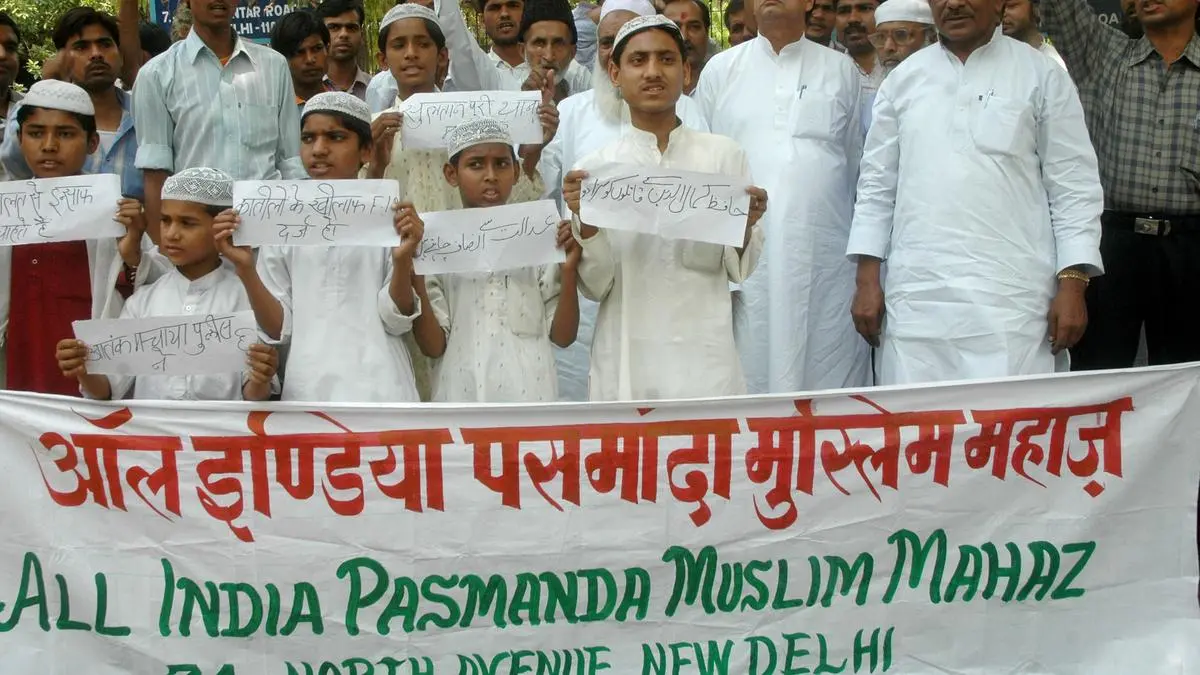
Indian Muslims are socially divided into three main groups: ‘Ashraf’ – who constitute approximately 15% of the population and are considered high-caste; ‘Ajlaf’, who represent lower-caste converts; and ‘Arzal’, who represent the untouchables. The marginalized ‘Pasmanda’ include socially, economically, and educationally deprived individuals from both ‘Ajlaf’ and ‘Arzal’ backgrounds, including Dalit and backward caste Muslims. The term ‘Pasmanda’ refers to those who have been left behind and come from lower castes and economically disadvantaged groups within Indian Muslim society. The Pasmanda movement emerged in the 1990s in response to the discrimination faced by lower-caste Muslims following the Mandal Commission. This community has been a vote bank for the Congress party since independence. With the emergence of regional parties after the 1980s, this vote bank shifted its allegiance to them with new hopes. But even after years, they stand at the same marginalized position they were in before.
Since the rise of the BJP, the Muslim community has been largely opposed to it. However, this perception is changing in recent elections. The BJP’s internal structure itself is changing with regard to Muslims, especially Pasmanda Muslims. During the BJP’s national executive meetings, Prime Minister Narendra Modi has emphasized the need to discuss the discrimination faced by Pasmanda communities, citing historical oppression within their own religion. Prime Minister Modi has highlighted the discrimination against various Pasmanda communities such as Mochi, Bhathiyara, Jogi, Madari, Julaha, Lohar, Teja, Lahari, and Haldar, stating that these communities have faced unjust prejudices for generations.
Muhammad Yunus, CEO of the All India Pasmanda Muslim Mahaz, has praised the Prime Minister’s focus on Pasmanda Muslim welfare, sparking a political debate. While the BJP is incorporating them into its electoral strategies, the opposition considers it divisive. Although Muslims constitute 20% of India’s total population, with approximately 80% being marginalized Pasmanda Muslims, the BJP advocates for their representation in democracy. The All India Pasmanda Muslim Mahaz supports the Prime Minister’s decisions and urges inclusive policies for Pasmanda communities. Azim Ahmad of the Delhi School of Economics views the BJP’s efforts positively, as they are bringing Pasmanda issues into electoral discussions. However, due to the BJP’s polarizing politics, Pasmanda Muslims remain hesitant about voting for the party. Nevertheless, the BJP’s efforts and welfare schemes could potentially sway Pasmanda votes in their favor. In BJP-ruled states, continuous efforts are being made to win over the Pasmanda community through various government projects, such as the Ujjwala Yojana, free rations, and the Pradhan Mantri Awas Yojana.
The BJP has also shown proactivity regarding the political representation of the Pasmanda community. In the 2023 Uttar Pradesh urban local body elections, the BJP fielded 395 Muslim candidates, reflecting a shift in the BJP’s engagement with Pasmanda Muslims. Questions are being raised about the representation of Pasmanda Muslims in the 2019 Lok Sabha elections. According to one analysis, out of 7,500 representatives elected from the first to the fourteenth Lok Sabha, 400 were Muslims, of whom 340 belonged to the Ashraf (upper caste) community. Only 60 Muslims from the Pasmanda community were elected across fourteen Lok Sabhas. According to the 2011 census, Muslims constitute approximately 14.2 percent of India’s population. This means that Ashrafs would constitute about 2.1 percent of the country’s population, but their representation in the Lok Sabha was approximately 4.5 percent. On the other hand, the Pasmanda community constituted approximately 11.4 percent of the population, yet their representation in Parliament was only 0.8 percent. Assembly elections are scheduled in West Bengal in 2026, and three districts in the state have a Muslim population of 50 percent or more, comprising 27 percent of the state’s total population. The majority of this population belongs to the Pasmanda community. Until now, the Muslim community in Bengal has largely stood united behind the Trinamool Congress, a fact reflected in the 2021 assembly election results. However, this equation appears to be changing following Humayun Kabir’s formation of a separate party and his decision to contest elections in nearly a hundred seats, and AIMIM’s Asaduddin Owaisi’s announcement to contest all seats in the state.
The BJP seems enthusiastic about the Pasmanda community. It is trying to win them over through national schemes, while Mamata Banerjee is attempting to consolidate their support by highlighting the issues of the CAA and NRC. The ongoing Special Investigation Report (SIR) in the state has given Mamata Banerjee another tool to maintain her relevance among Muslims. Meanwhile, the BJP is trying to reach out to the Pasmandas through the Waqf Amendment. BJP Minority Morcha National President Jamal Siddiqui has stated that the Waqf (Amendment) Bill passed by Parliament is designed to improve the lives of economically weaker Muslims. He emphasized, “The opposition parties, which have long used the Muslim population as their vote bank, are once again trying to mislead poor Muslims with this bill. However, Muslims living in economically and educationally backward conditions can no longer be deceived.”
In his statement Jamal Siddiqui explained that the campaign would be executed by Minority Morcha functionaries from various sections of the Muslim community. He also cited a recent initiative during Eid, where “Saughat-e-Modi” kits containing food and essentials were distributed to impoverished Muslims. “Prime Minister Narendra Modi is genuinely concerned about the development of poor Muslims. He wants prosperity for everyone, regardless of their caste or creed. The Prime Minister is dedicated to lifting poor Muslims out of poverty and addressing the educational challenges they face by promoting education and providing economic empowerment. The opposition, on the other hand, has nothing in its agenda but to mislead the Muslim community for electoral gains,” he said.
Chief Minister Mamata Banerjee, keeping in mind the backward Pasmanda community of the state, has revised the OBC list and included 76 new communities in it. These mainly include Ansari, Momin, Muslim Mandal, Muslim Biswas, Gaen, Piyada, Muslim Dafadar, Muslim Darzi, Muslim Sardar, Dhali, Sarkar Muslim, Mistri Muslim, Paik Muslim, Mal Muslim, Dhabak Muslim, Naiya Muslim, Siuli Muslim, etc. This is likely to directly benefit the Pasmanda community.
All political parties and alliances are trying to woo Pasmanda voters in the upcoming elections. While the BJP is trying to make inroads into this vote bank at the national level, the Trinamool Congress is busy trying to protect its traditional vote bank. But this tug-of-war has made it clear that Pasmanda voters will be at the center of attention for all parties in this election.

January 13, 2026 @ 9:27 PM
Perfect review