PDA Politics and the Dalit Question: The Samajwadi Party’s Calculated Shift Ahead of 2024
In India’s electoral arena, the Dalit vote continues to be courted aggressively, often more in rhetoric than action. But in recent months, the Samajwadi Party (SP) has sought to redefine this engagement, moving beyond traditional caste equations and introducing a broader socio-political coalition under the banner of PDA — Pichhda (Backward), Dalit, Alpsankhyak (Minorities).
The PDA formula, promoted by SP chief Akhilesh Yadav, represents more than an acronym. It signals a recalibration of the party’s ideological base. By placing Dalits, backwards classes, minorities, and even women under a broader category of “historically wronged groups”, the party is making an ambitious pitch to claim moral and political leadership over the marginalised majority. The underlying idea: that oppression in India is layered — social, economic, educational, and cultural and therefore, the Dalit identity is not confined to one caste alone.
This conceptual expansion is rooted in socialist thought. Thinkers like Dr Ram Manohar Lohia and Babasaheb Ambedkar have long argued that caste- based and class-based discrimination are intertwined. By aligning itself with this intellectual tradition, the SP positions itself as more than a caste- based party, instead, it seeks to be a party of the marginalised, across all social divisions.
However, what makes it notable in 2024 is the party’s renewed attempt to walk the talk from fielding Scheduled Caste candidates on general category seats (notably in Faizabad & Meerut), to naming dedicated party departments after icons like Ambedkar.
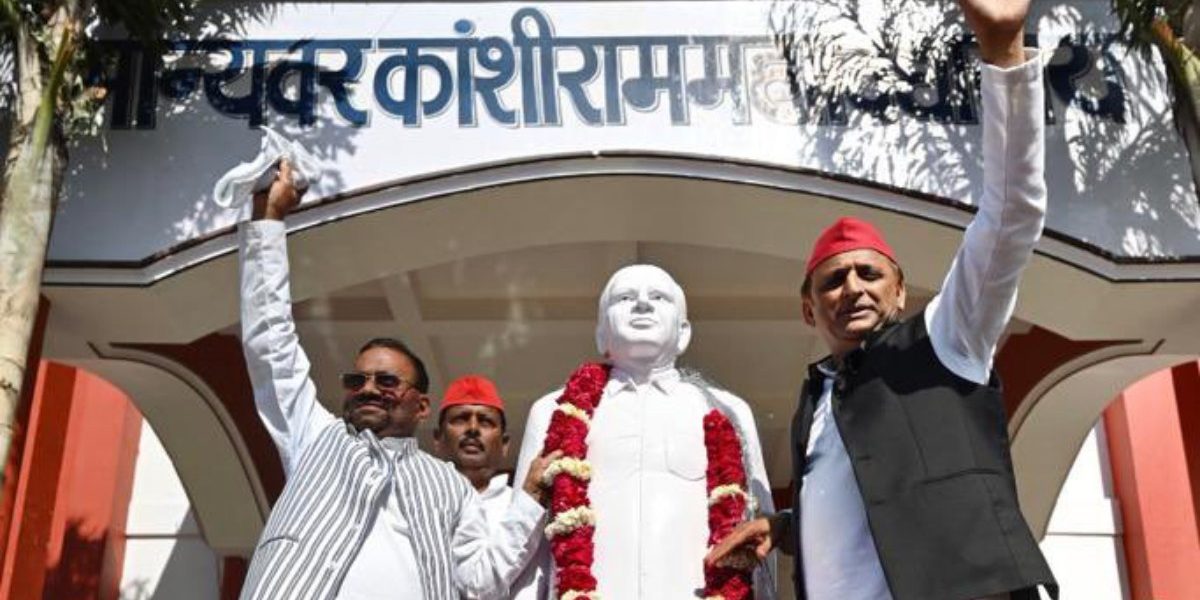
The SP is making symbolic and strategic moves to counter accusations of being narrowly Yadav-centric. The party is also invoking its legacy of Mulayam Singh Yadav, to strengthen its claim as a long-standing ally of the oppressed. One of Mulayam’s earliest political movements, as the party recalls, was against the injustice faced by Dalit women, a campaign that even led to his imprisonment. Later, as Chief Minister, his government , and subsequently Akhilesh Yadav’s administration (2012– 2017) , introduced welfare schemes that benefitted farmers, girls, and poor students: free irrigation, the Kanya Vidya Dhan scheme, accident insurance for farmers, and free laptops for youth.
These policies, the party argues, are not caste-specific but class-conscious, aimed at uplifting the very sections clubbed under the PDA umbrella. The party sees this as a counter to the BJP’s model, which it accuses of deploying “fake Hindutva” — a political Hindutva, divorced from spirituality and aimed at creating communal divisions. In contrast, the SP claims its vision is one of development-driven politics: employment, healthcare, education, and dignity for all.
But criticism remains. The party is frequently accused of promoting “Yadavism” and not giving adequate space to Dalit leadership. The limited electoral scope given to Dalit parties like Chandrashekhar Azad’s Bhim Army further fuels these doubts. The SP, in response, distances itself from the internal choices of other parties but maintains that its own record shows progressiveness, not exclusion. Another contentious issue is the renaming of districts, universities, and institutions after Dalit icons — a move actively pursued by the Bahujan Samaj Party (BSP) under Mayawati but quietly reversed or diluted during SP regimes. The justification offered now is that these changes were driven by local sentiment , residents preferred older or historically rooted names. Yet, there’s a notable admission: that keeping those names might have been a better decision. It’s a rare moment of political reflection, even if carefully worded.
Importantly, the SP is not backing away from Ambedkarite symbols. Instead, it promises to go beyond nameplates by building real institutions: universities, hospitals, colleges, and memorials. The idea is to convert symbolic respect into tangible infrastructure that benefits the Bahujan community. The reference to Janeshwar Park in Lucknow , touted as India’s largest urban park, exemplifies that scale of ambition. The political signal is clear: the Samajwadi Party aims to set itself apart from the BJP’s majoritarianism and the BSP’s narrow identity politics. With PDA, it seeks a middle path, merging representation with welfare, legacy with vision.
Whether this will convert into votes is uncertain. But the SP is clearly moving beyond its old “Yadav-Muslim” image, aiming to craft a broader social alliance rooted in dignity, justice, and inclusion, with the Dalit voter at its core.