Who Is Arundhati Roy to Claim Ambedkar’s Legacy? A Critique of Appropriation
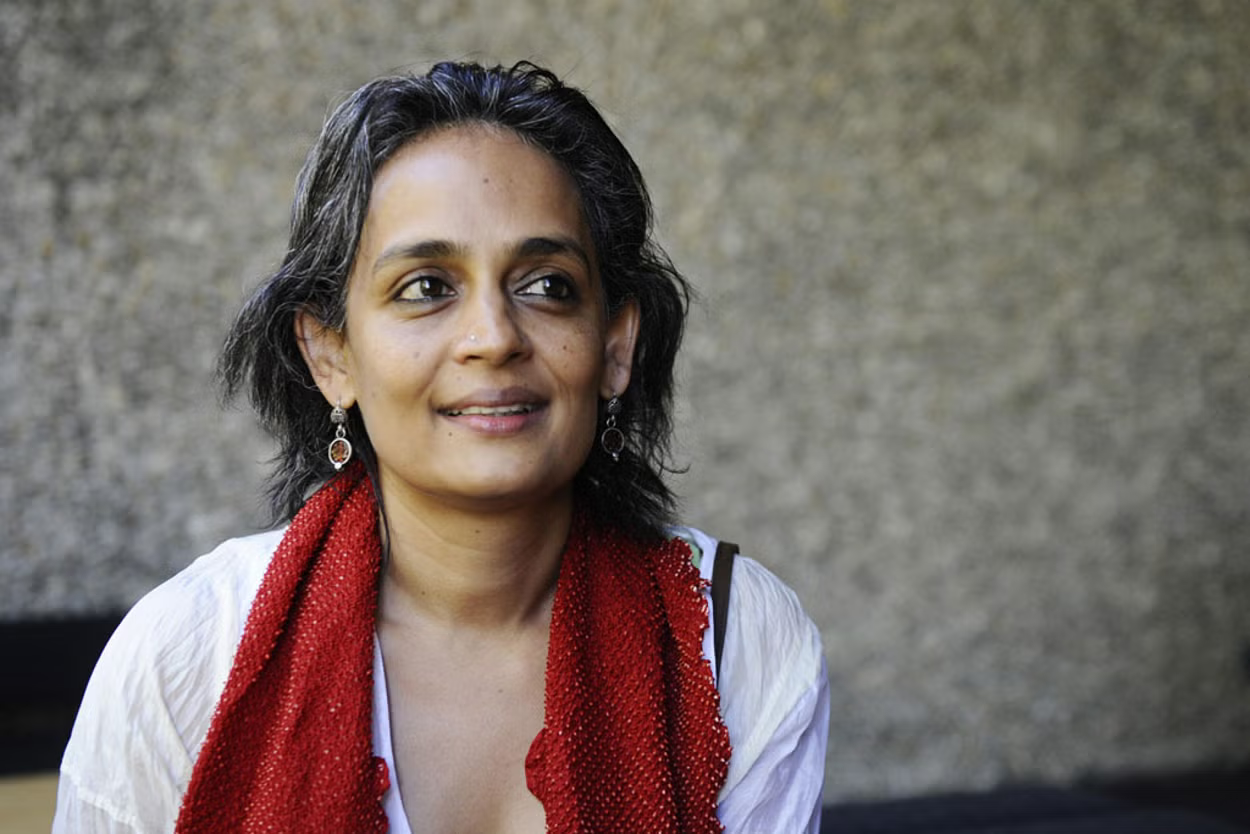
Arundhati Roy’s preface to Dr. B.R. Ambedkar’s Annihilation of Caste, titled The Doctor and the Saint, is a sharp political essay—but one that ultimately reflects a troubling pattern: the appropriation of Dalit discourse by Savarna intellectuals. Though Roy claims to elevate Ambedkar’s radical politics, her essay asserts a dangerous authority over his voice, re-establishing caste privilege in the very act of dismantling it.
Roy’s own lineage—Syrian Christian mother and Brahmin father—places her squarely within the Savarna fold. She acknowledges these roots, yet fails to confront the privileges they confer. The Syrian Christian community in Kerala, claiming descent from Brahmin converts, remains culturally Hindu, economically dominant, and staunchly endogamous. Roy grew up surrounded by privilege: her mother, Mary Roy, founded a prestigious school; her family owned land, enjoyed financial stability, and lived far removed from caste persecution. Her memories of a segregated Dalit church serve more as anthropological asides than political reckonings.
I met Arundhathi Roy twice—once during the anti-CAA protests in Delhi and again at a magazine launch in the Constitution Club. When I brought up my stance on the Sabarimala issue, she dismissed it harshly. Her explanation of enjoying caste privilege “by accident” felt hollow. Privilege is not accidental—it is systemic, generational, and fiercely guarded. Her defence, echoed by others on the panel, that the privileged contribute meaningfully to society, missed the point: they often dominate spaces meant for the oppressed, diluting radical energy with liberal sentiment.
I hold deep respect for Arundhati Roy and her contributions to political discourse, yet my personal interactions with her have been profoundly disheartening. During the CAA protests, when I approached her with sincerity and hope, I was met with a cold and dismissive response that left me feeling insulted and unwelcome.
Despite several attempts to connect further, including messages on WhatsApp, I received no acknowledgement. As a Dalit woman who had faced attacks from both right- wing extremists and state machinery, I had expected solidarity, especially from someone who speaks so strongly on behalf of the oppressed. Instead, what I experienced was silence. Her selective engagement with Dalit and Adivasi issues, seemingly reserved for moments that elevate her public stature, felt deeply painful. It revealed a troubling gap between her advocacy and her personal ethics—one where the lived struggles of marginalised individuals like me are too easily ignored.
Roy’s engagement with Ambedkar’s work, while eloquent, is often orthogonal or tangential, as scholar A. Gajendran notes. Her writing swims valiantly across waters she was never submerged in. Her preface is less a bridge and more a detour—a narrative of caste seen through a Savarna lens, wrapped in literary flair and personal memory. Her use of terms like “endosmosis” and “purity-pollution” may signal intellectual engagement, but it lacks the political accountability that true solidarity demands.
The fact that Roy a Savarna was chosen to introduce Ambedkar’s most scathing critique of Hinduism, a speech originally rejected by upper-caste reformers, drips with irony.
For decades, Savarna elites ignored, marginalised, and resisted Ambedkar. That his words must now be “validated” by a globally recognised Savarna writer only reinforces the caste system’s insidious hold. Roy does not translate Ambedkar for the masses,she filters him.
Her critique of Gandhi is fierce and needed. But she inserts herself as the mediator of Ambedkar’s rage, thus recentralizing Savarna authority in a space Ambedkar had carved out precisely to escape it.
Roy’s framing often reduces Ambedkar to a class-conscious thinker within the Marxist paradigm, misreading Ambedkar. But he was critical of the Left, particularly its caste-blindness. He exposed communist parties for their upper-caste dominance and failure to recognise caste as an autonomous axis of oppression. Her preface barely addresses Ambedkar’s conversion to Buddhism—his rejection of Hinduism wasn’t just spiritual, it was a political break from the casteist cosmos. By glossing over this, Roy misrepresents Ambedkar’s core project: not just class struggle, but annihilation of caste and the creation of a new ethical order.
Roy’s prominence eclipses generations of Ambedkarite scholars, Kancha Ilaiah, Sharmila Rege, Anand Teltumbde, Suraj Yengde, whose work stems from lived struggle. When a single Savarna writer overshadows an entire movement’s intellectual output, it becomes an act of epistemic violence and silencing Dalit Thinkers.
Her preface scarcely references contemporary Dalit movements or voices. Her narrative is fixed in the past, where she can control the frame.
This is not amplification, it’s substitution.
The heart of the issue lies here: is Roy standing with the oppressed or instead of them? True solidarity requires decentering oneself, making space for others. Roy, by contrast, recenters herself, she becomes the saint who introduces the doctor, and her solidarity leads to substitution.
Her liberal framework cannot contain Ambedkar’s fire. He did not ask for mediation, he demanded confrontation. Roy’s presence, even if well-intentioned, neutralises this rage, making Ambedkar palatable to elites who still flinch at caste’s raw truths.
Roy may not intend harm, but her role reveals how caste operates even in radical spaces. The Left, often blind to caste privilege, has celebrated her essay as a gift. It is not. It is a cautionary tale.
Ambedkar does not need rescuing by Savarna authors. He needs amplification from the margins, from those who know what it means to live, suffer, and fight caste. Roy’s words are not inherently illegitimate, but they cannot be allowed to overshadow Dalit voices, histories, or futures.
Ambedkar never craved Savarna validation. He knew they found his presence “repugnant.” He knew Hindu society was not a society, it was a system of castes, each closed, competing, and segregated. The term “Hindu” itself, he reminded us, was foreign, imposed, and meaningless in a context where public spirit, charity, or collective responsibility had no ground. Caste, he said, made morality impossible. It created a world where virtue, empathy, and responsibility began and ended at caste lines.
He saw through the fraud of religion-as- ritual, demanding instead a religion of principles rooted in justice, reason, and equality.
Ambedkar’s call was not for moderation, it was for emancipation through radical reform, through moral courage, and through annihilation, not accommodation, of caste. “You must make your own efforts to uproot caste,” he said. “If not in my way, then in your way.”